Did Tycho Brahe die because he was too polite to pee?
The astronomer Tycho Brahe fell ill after a Prague banquet where he held it in. What Kepler recorded, what his exhumations found, and why you shouldn’t hold it.
There is a rule older than any in our list, and it’s the one men break most often: when you need to go, go. In 1601 one of the greatest scientists in Europe broke it at a dinner party in Prague, and history has never let him forget it.
The astronomer
Tycho Brahe was a Danish nobleman who measured the stars more precisely than anyone before the telescope. He was also unforgettable in person. He had lost part of his nose and wore a replacement, which legend made of silver or gold. By 1601 he was working in Prague for Emperor Rudolf II, with a young assistant called Johannes Kepler.
The banquet
In October 1601 Tycho went to a banquet at the Hradčany residence of the nobleman Petr Vok of Rožmberk (Rosenberg, in German). It was a grand occasion, and leaving the table early was bad manners.
So he didn’t.
According to Kepler, who was in Prague at the time, Tycho held back his water out of courtesy rather than excuse himself. When he finally got home, he could barely pee: only a little at a time, and painfully. He grew worse, was delirious on his last night, and died on 24 October 1601, eleven days after the banquet. He was 54.
That is the origin of the story that the great astronomer died because he was too polite to go to the toilet.
Did his bladder burst?
Probably not. “Burst bladder” is the version everyone repeats, and it even made headlines in 2012. But nobody has proven it, and it isn’t what the researchers who studied him actually concluded.
A doctor at the time blamed a kidney stone. When his grave was opened in 1901, no stone was found. Modern opinion leans towards urinary retention, the bladder unable to empty, perhaps caused by an enlarged prostate or an infection, leading in turn to kidney failure. The honest answer is that the exact cause is still debated.
The murder theory, and the second exhumation
In the 1990s, tests on hair from the 1901 exhumation found unusually high mercury. Suddenly there were murder theories, with Kepler himself among the suspects.
So in November 2010 a Czech-Danish team led by archaeologist Jens Vellev opened the grave in Prague’s Týn Church again and took samples of bone, hair and clothing. In 2012 they reported the result: three different methods all found mercury levels far too low to have killed him. His bones showed no unusual mercury exposure in his last years. Mercury poisoning was ruled out.
They also settled the nose. Stains on the skull showed equal parts copper and zinc. The famous nose was brass.
Visiting Tycho in Prague
He’s buried in the Church of Our Lady before Týn, on Old Town Square, under a red marble tombstone showing him in armour, one hand on a celestial globe. Local folklore says stroking the carved face cures toothache. We make no claims.
The lesson, minus the legend
Holding it in at one dinner won’t kill a healthy man. But Tycho’s story is a reminder of something real: when peeing becomes slow, painful or impossible, that is a medical problem, not a character flaw.
- Trouble starting, a weak stream or getting up at night? Read Peeing more at night?.
- If you suddenly can’t pee at all, that’s an emergency. Get help straight away.
Prague in the game
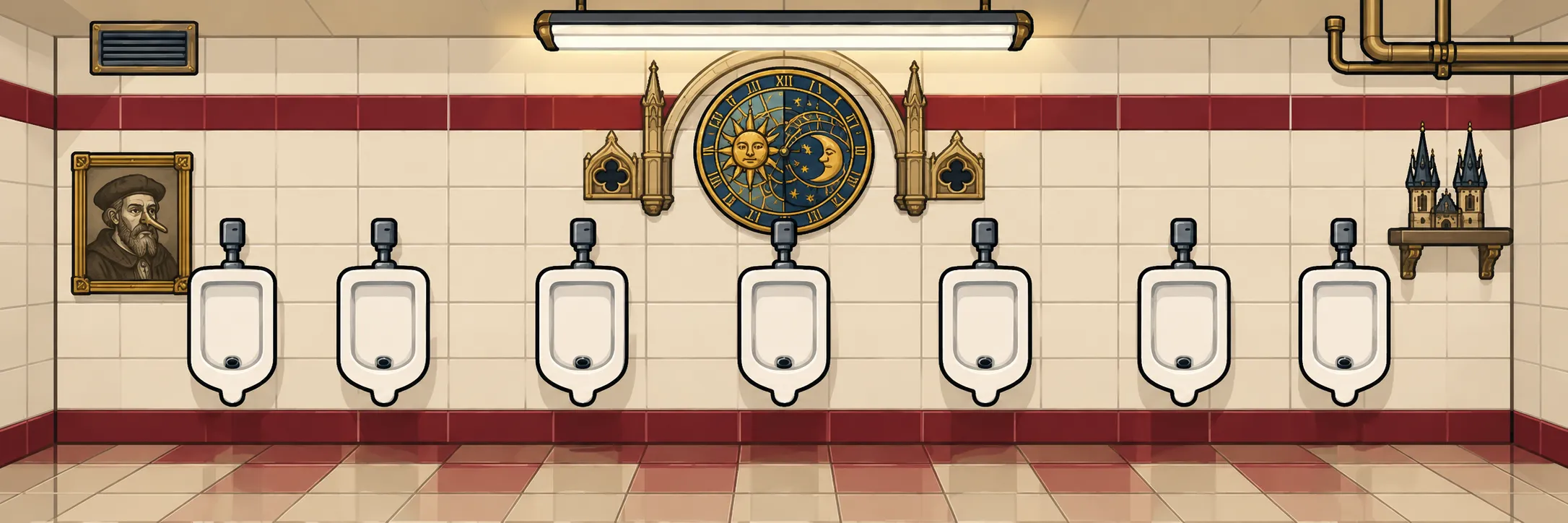
Prague is one of the airports in Urinal Rules Forever, and Tycho is on the wall. The Field Notes put it gently: “The astronomer’s nose is brass. His expression says he should have excused himself.”
Learn from him. Excuse yourself.
Quick answers
How did Tycho Brahe die?
He fell ill after a banquet in Prague in October 1601, where, according to Johannes Kepler, he held in his urine rather than leave the table. He could barely pee afterwards and died eleven days later. The exact medical cause is still debated.
Did Tycho Brahe’s bladder burst?
Probably not. That is the popular version, but it is not proven. Modern opinion leans towards urinary retention, possibly from an enlarged prostate or an infection, leading to kidney failure.
Was Tycho Brahe poisoned with mercury?
No. After his grave in Prague was opened in 2010, tests on his bones and beard found mercury levels far too low to have killed him. Researchers ruled out mercury poisoning in 2012.
Sources