Manneken Pis: the true story of Brussels’ most famous little boy
Manneken Pis facts and legends: how old the statue really is, why the one on the corner is a copy, the thefts, and his 1,000-outfit wardrobe.
He is about 61 centimetres tall, he has been relieving himself in public for four centuries, and crowds still queue to photograph him. There is no other city in the world where this would work. In Brussels it’s a national treasure.
How old is he?
Older than you think, in two ways.
A fountain figure of a peeing boy was already part of the city’s water supply in the 15th century: it is mentioned in records from 1451–52. The bronze we know was commissioned by the city council in 1619 from the sculptor Jerome Duquesnoy the Elder, and was probably installed in 1620. His stone niche was added in 1770.
For centuries he wasn’t a joke at all. He was plumbing. The statue supplied water to the neighbourhood, survived the French bombardment of 1695, and only lost his job in the water network in the 19th century.
The one on the corner is a copy
The boy tourists photograph today is a bronze replica, in place since 1965. The 1619 original lives indoors, in the Brussels City Museum on the Grand-Place.
There’s a good reason he was moved inside. People keep stealing him.
A history of kidnappings
- 1740s: soldiers tried, or managed, to carry him off. Historians still argue about whether it was a theft or only an attempt, and about which army did it. Tradition says Louis XV later gave him a gentleman’s outfit by way of apology.
- 1817: a freed convict stole him, and he was found broken into eleven pieces. He was repaired and recast.
- 1955 and 1957: attempted thefts.
- 1963: students from Antwerp took him.
- 1965: thieves tore him from his pedestal one night, leaving only his feet. He turned up the following June in the Brussels–Charleroi canal, after an anonymous tip, and was fished out by divers.
After that, the city put the copy outside and the original under lock and key.
The wardrobe
Manneken Pis is the best-dressed statue on Earth. He owns more than 1,000 costumes. His 1,000th outfit, by designer Jean-Paul Lespagnard, arrived in 2018, and new ones keep coming.
The earliest evidence of him being dressed goes back to 1615. The first recorded costume was a gift from Maximilian II Emanuel of Bavaria in 1698.
Dressing him is a real job. A City of Brussels employee changes his clothes, with 23 dressings on fixed dates each year. Anyone can offer a new costume, but there is a process: a formal request to the mayor, review by a commission that includes the Friends of Manneken-Pis, and a firm rule against anything commercial, political or religious. Part of the wardrobe is on show at the GardeRobe MannekenPis museum, which opened in 2017 a short walk from the statue.
On certain festival days he’s hooked up to a keg and serves the crowd beer instead of water. Brussels has its own idea of a fountain.
The legends (none of them true)
Everyone in Brussels has a favourite origin story. None is documented. Among the best known:
- The baby duke: in 1142, two-year-old Duke Godfrey III was hung in a basket from an oak during a battle, and peed on the enemy, who lost.
- The burning fuse: a boy saved the city by peeing on the fuse of a bomb left by besiegers.
- The lost child: a rich man’s missing son was found peeing on this very corner, and his grateful father paid for the statue.
They are legends, in other words. The real story, a working fountain that became a mascot, is less heroic but more Belgian.
He has a sister, and a dog
In 1987 a restaurateur added Jeanneke Pis, a little girl squatting in an alley off Rue des Bouchers. In the late 1990s the sculptor Tom Frantzen added Zinneke Pis, a bronze dog cocking his leg against a bollard. “Zinneke” is Brussels dialect for a mutt. The full family can be done on foot in an afternoon.
Brussels in the game
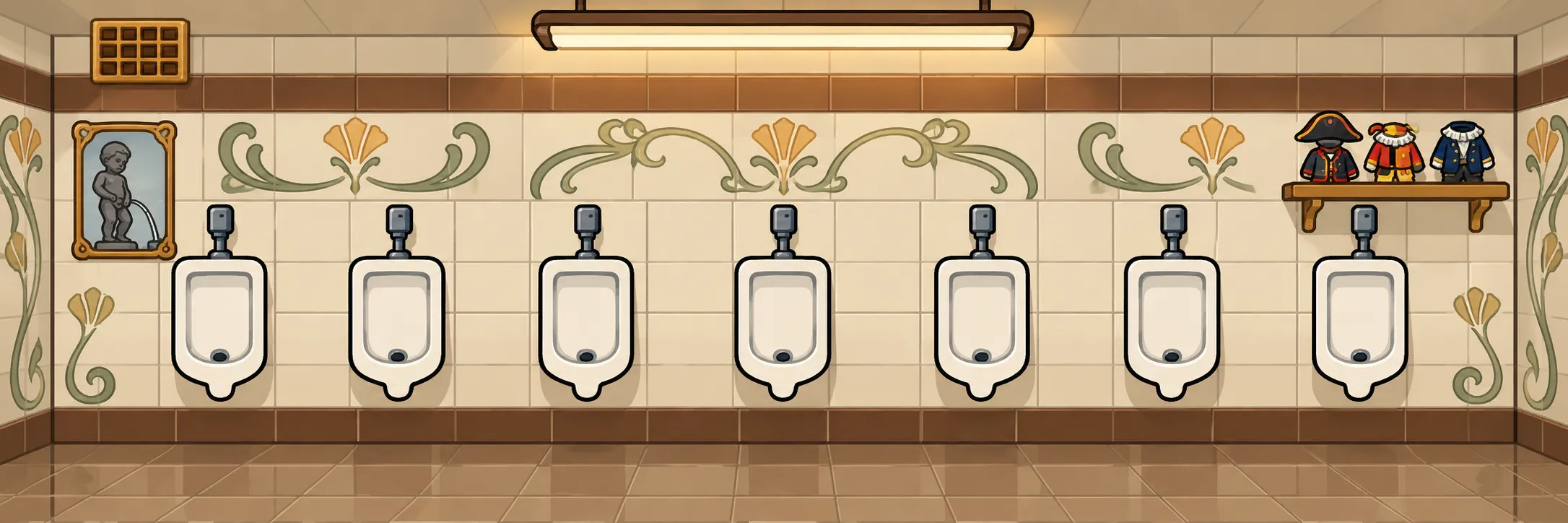
Brussels is one of the airports in Urinal Rules Forever. His picture hangs on the restroom wall, and the Field Notes give him the respect he’s earned: “The city’s most famous resident. On duty since 1619. No breaks, no complaints.”
Unlike him, you are expected to pick a urinal with care. Here are the rules. For another story about the world’s most famous urinals, read about the Schiphol fly.
Going to Brussels with the lads? Send this to the group chat first. Whoever finds Jeanneke and Zinneke buys the first round.
Quick answers
Is the Manneken Pis in Brussels the original?
No. The statue on the street corner has been a bronze replica since 1965. The 1619 original is kept in the Brussels City Museum on the Grand-Place.
How old is the Manneken Pis?
The current bronze was commissioned in 1619 from the sculptor Jerome Duquesnoy the Elder. A fountain of a peeing boy stood on the spot much earlier, mentioned in records from the 1450s.
How many costumes does Manneken Pis have?
More than 1,000. His 1,000th outfit arrived in 2018, and the collection keeps growing. Part of it is on show in the GardeRobe MannekenPis museum nearby.
Sources