Paris street urinals: the vespasiennes, the last one standing and the red ones nobody wanted
Paris once had more than 1,200 street urinals. How the vespasiennes got their name, where the last one survives, and what replaced them.
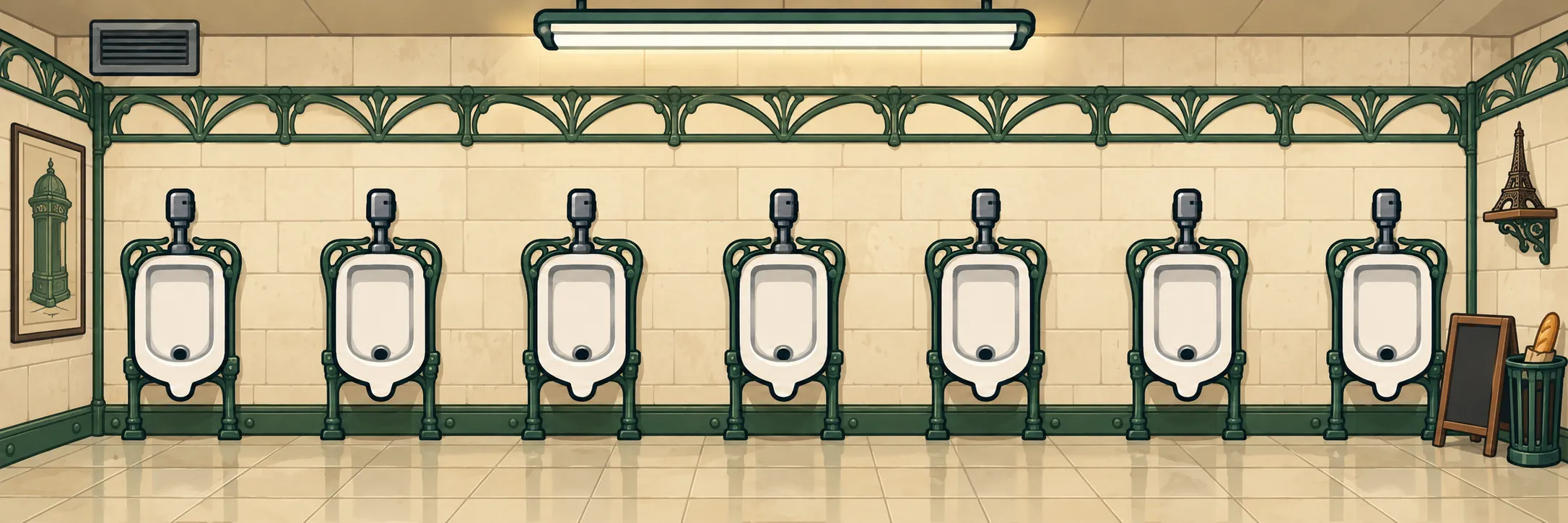
Every great city has a monument to the thing everybody does and nobody mentions. In Paris it is a green cast-iron column on Boulevard Arago, and it is the last of its kind.
How Paris got its street urinals
In the 1830s and 1840s, Claude-Philibert de Rambuteau, Prefect of the Seine, began installing public urinals on the streets of Paris. Sources disagree on the exact start year; what they agree on is that more than 400 were in place by 1843.
Parisians called them colonnes Rambuteau, after the man responsible. Rambuteau, the story goes, preferred another name: vespasiennes, after the Roman emperor Vespasian, who taxed the urine collected from Rome’s public urinals. Naming your public toilets after someone else is a power move. It worked. The name stuck.
They spread. By the early 20th century Paris had more than a thousand street urinals. One study puts the peak at 1,230 in 1931; other accounts give a higher figure for around 1900. Either way, a Parisian man was rarely far from one.
The long goodbye
The city voted to phase them out in 1959, changed its mind in 1961, and let them disappear anyway. In 1981 the administration of mayor Jacques Chirac voted to remove the rest. A 1984 photo series shows the cast-iron urinals rusting in a field outside Paris, at Argenteuil.
Their history isn’t only comic. Police used the urinals to target gay men, recording hundreds of indecency arrests in the 1870s alone. In 2019 Paris held its first exhibition about them, Les Tasses, at Point Éphémère. Tasse, literally “cup”, is old slang for a street urinal.
The last one standing
One historic vespasienne survives: on Boulevard Arago, in the 14th arrondissement, outside the walls of La Santé prison. The geographer Marianne Blidon called it la dernière tasse de Paris, the last cup. Nobody seems to know why it was spared. One theory is simple administrative oversight.
It stands by a prison wall, which the curator of Les Tasses called an unconscious warning about where bad behaviour might lead. If you visit, keep it brief. Everyone else does.
The Resistance legend. You’ll read that the French Resistance used pissoirs to pass messages and weapons under the noses of the Nazi occupiers. It’s a great story. We couldn’t find a documented case or a historian’s footnote behind it, so treat it as legend.
What replaced them: the Sanisette
From 1980 the city brought in the Sanisette, JCDecaux’s self-cleaning, unisex street toilet. After every visit the cabin washes and disinfects itself in about a minute. In 2006 Paris began making them free, and finished converting them in 2014.
That’s progress: a toilet anyone can use, for nothing, cleaned by a robot. It is also, for the urinal purist, a loss. There is no etiquette in a cabin for one.
The red ones nobody wanted
In 2018 Paris tried open-air urinals again, with a twist. The uritrottoir is a bright red box filled with straw that composts the urine and feeds a flower bed on top. Three went in that March and a fourth in July.
The one on the Île Saint-Louis, by the Seine and a short walk from Notre-Dame, caused uproar. A local gallery owner called it “an open door to exhibitionism”. Residents protested, and that unit was later moved. Proof that Parisians will tolerate a lot, but not a man peeing into a flower box with a view of the river.
Paris in the game
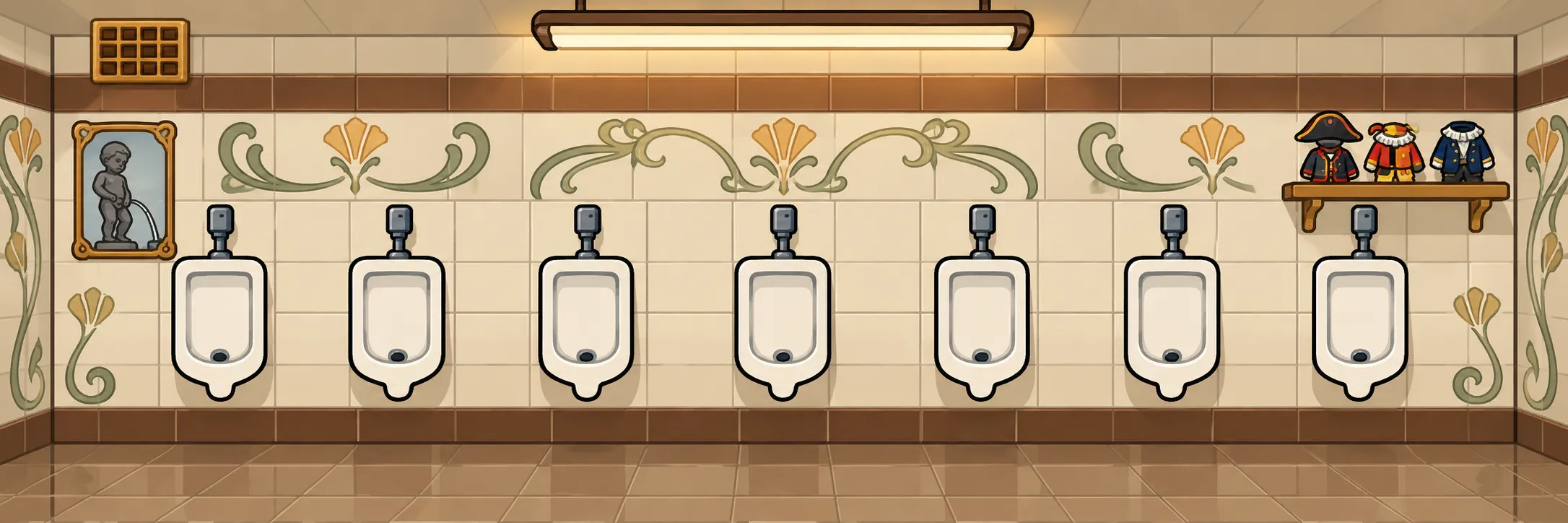
Paris Charles de Gaulle is one of the European airports in Urinal Rules Forever. Look for the framed portrait of a green street urinal on the wall. In Paris, even this is art. Going to Paris? Send this to the mate you’re travelling with; he’ll need it by day two. Next stop on the urinal tour of Europe: the Schiphol urinal fly.
Quick answers
What is a vespasienne?
A public street urinal in Paris. The name comes from the Roman emperor Vespasian, famous for taxing urine. Paris had more than a thousand of them in the early 20th century.
Is there still a vespasienne in Paris?
One historic vespasienne survives, on Boulevard Arago in the 14th arrondissement, outside the walls of La Santé prison.
Are public toilets in Paris free?
Yes. Paris’s self-cleaning street toilets, the Sanisettes, have been free since the city began converting them in 2006.
Sources