Did Thomas Crapper invent the toilet? And where “spend a penny” comes from
No, Thomas Crapper didn’t invent the flush toilet, or the word “crap”. The real story, plus the 1851 penny toilets behind “spend a penny”.
Some men get statues. Thomas Crapper got his name on a word he didn’t invent, for a machine he didn’t invent either. It’s still more than most of us will manage.
The short answer
No, Thomas Crapper did not invent the toilet. Flushing toilets go back at least to John Harington, who designed one in 1596, and to Alexander Cumming, who patented the S-bend trap in 1775. Crapper wasn’t born until 1836.
The Science Museum puts it plainly: he clearly didn’t invent the toilet. What he did was sell a lot of very good ones.
Who Thomas Crapper actually was
Crapper was a real London plumber. He was baptised in 1836, set up his own business in 1861 and died in 1910. He held nine patents, three of them for improvements to the water closet, such as the floating ballcock. None was for the flush toilet itself.
He was also a great promoter. According to the Science Museum, he popularised the siphonic flush, which was invented by Albert Giblin. His firm held royal warrants, and manhole covers bearing the company name in Westminster Abbey have become a small tourist attraction. Look down; men rarely do.
Where the myth came from
Much of the legend traces to a 1969 book, Flushed with Pride, by Wallace Reyburn: a tongue-in-cheek biography that a lot of people took at face value. Fifty years later, the internet is still flushing it round.
Did “crap” come from Crapper?
Also no. The word is older, probably from Dutch krappen or Old French crappe. The Oxford English Dictionary’s first record of “crap” meaning bodily waste is from 1846, when Crapper was about ten. The Science Museum calls his connection to the word coincidental.
And “the crapper”? A popular story says American soldiers in the First World War saw his name on cisterns in England and took the word home. It’s a good story. Nobody has proved it.
“Spend a penny”: the 1851 toilets
The real hero of the British toilet is a man with a less memorable name: George Jennings.
At the Great Exhibition of 1851, in the Crystal Palace, Jennings installed flushing public toilets he called “Monkey Closets”. Visitors paid one penny, which bought a clean seat, a towel, a comb and a shoe shine. Hundreds of thousands of people paid; sources disagree on the exact number.
When the Exhibition ended, the toilets were due to close. Jennings persuaded the organisers to keep them open, and they went on earning money.
“Spend a penny” became the British way to say you’re going to the toilet, and it’s widely linked to those penny toilets. That link is likely but not proven: nobody has found the phrase’s earliest use.
London’s first public “waiting rooms” with toilets for men followed: the first opened on Fleet Street in 1852, with one for women in Bedford Street days later.
In 2016, builders in Hyde Park dug up toilet remains from the Great Exhibition. They turned out to be an earth closet, the older non-flushing kind, not one of Jennings’s. Even the archaeology refuses to give him credit.
London in the game
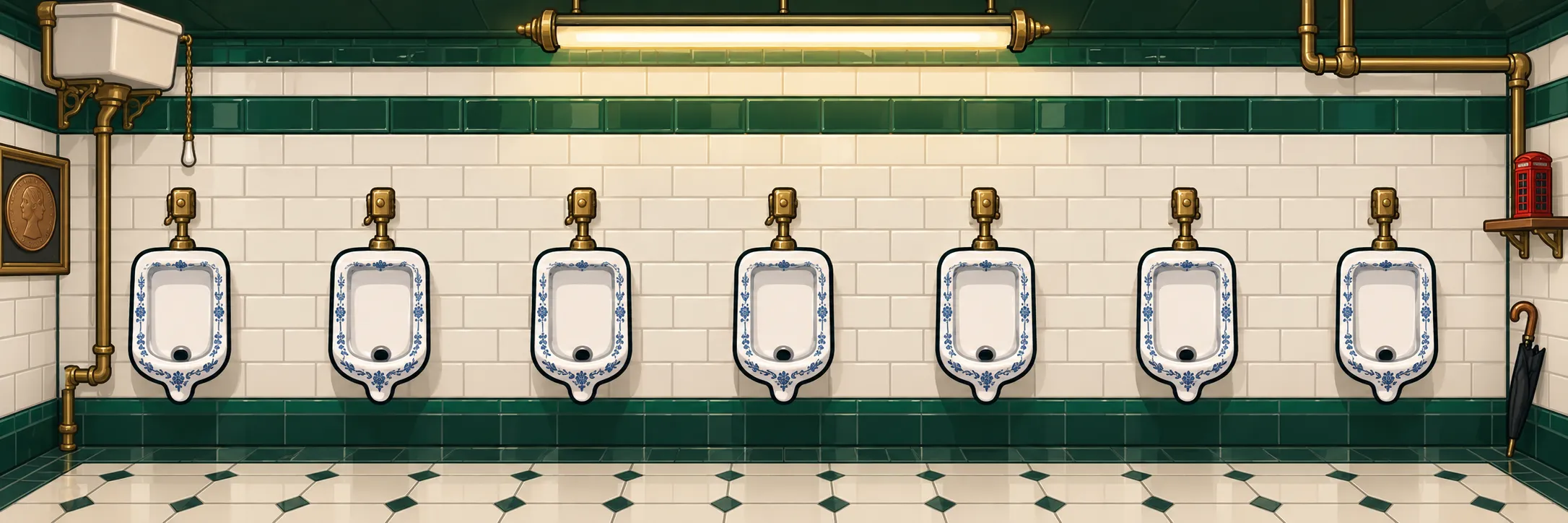
London Heathrow is one of the European airports in Urinal Rules Forever. There’s a penny in a frame on the wall. It used to get you in. Now it gets you nothing. Inflation.
Next time someone at the pub says Crapper invented the toilet, you know what to do. Send him this. Then read the unwritten rules of the urinal, which nobody invented either.
Quick answers
Did Thomas Crapper invent the toilet?
No. Flushing toilets go back to John Harington in 1596 and Alexander Cumming’s 1775 patent. Crapper was a successful Victorian plumber who improved and popularised them.
Does the word “crap” come from Thomas Crapper?
No. The word is older. The Oxford English Dictionary’s first record of it meaning bodily waste is from 1846, when Crapper was about ten.
Where does “spend a penny” come from?
It is widely linked to the 1851 Great Exhibition in London, where George Jennings’s flushing toilets cost one penny. The link is likely, but nobody has found the phrase’s earliest use.
Sources